
Srivaishnavam Parambaryam, Traditions & The Culture that stands Class apart from othersEssence of Srivaishnavam Practices – Tulsi – Thulsi – Thulasi – तुल्सि – துளஸி

TRS Iyengar
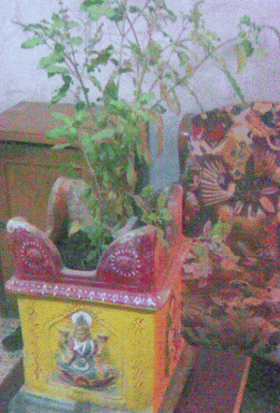
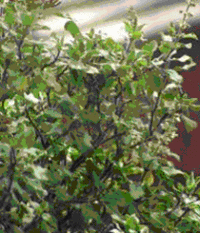
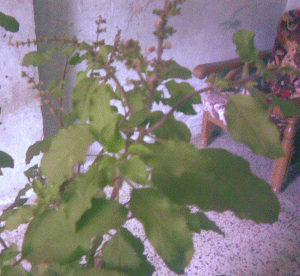
The Botanical name of Tulsi is Ocimum tenuiflorum (commonly known as Holy basil in English, Thiruthuzhai in Tamil and Tulasi or Tulsi in Sanskrit); this plant is a close cousin of the Thai Basil. It is a well known natural aromatic plant in the family of Lamiaceae. Apart from its culinary uses, for which it is known across the world, it is also used as a medicinal plant, and has an important role within many traditions of Srivaishnavites and also generally with every Hindu Household. Every Vishnu devotee performs worship using Tulasi leaves. Native to India, it is a short lived perennial herbal, grown at most Hindu homes. The foliage is green or purple, strongly scented. Leaves have petioles, and are ovate, up to 5cm long, usually somewhat toothed. Flowers are white, tinged purple, borne in racemes. There is also some confusion among the users, that Thai basil is mistakenly sold as Sacred basil. The fact is, the Sacred Holy basil – The Tulsi is little hairy wherein Thai Basil is smooth and hairless and slightly different in its color. Also, the Sacred or Holy basil has an aromatic scent and spicy flavour, which is not so with its cousin Thai Basil.
Thulsi or Tulsi, a common household name to millions of Indian & Hindus Thulsi (Tulsi) is the ultimate symbol of purity. The only one word, yes – Thulsi (Tulsi) is referred to, in all Indian languages, (Ocimum sp. or Ocimum Sanctum) known as Holy Basil. The only exception is in Tamil, {Though every Tamilian knows it as Thulsi (Tulsi)}. wherein Sri Andal refers to Thulsi or Tulsi as “Natrathuzhai” meaning as a scented beautiful smelly Holy Basil.! For all Srivaishnavas, Thulasi (Tulsi) is known as Thiruthuzhai. Every Hindu is well aware of this plant and knows its value too!
What Rg Veda, Charaka Samhita state about Holy or Sacred basil – Tulasi
Known as Tulasi (alternate spelling Tulsi) in India it is an important religious symbol in many Hindu traditions that link the plant with the Goddess figure described in the ancient scripts known as Purana. The name “Tulasi” in Sanskrit literally means “the incomparable one”. The Tulasi plant is known in India is available and grown in two forms viz. dark Krishna or Shyama Tulsi and White or light green known as Rama Tulasi or White Tulsi. Though both the Tulsi plant possess a lot of medicinal value, the former has greater medicinal value and is commonly worshipped by Hindus.
In India, that is Bharat, from time immemorial, Tulasi has been known and worshiped and used as a prime herb in Indian Medicine known as Dhanvantri and Ayurvedic medicines. It is also used as home remedy for treating commonly known ailments and used mainly for its diverse healing properties. The Charaka Samhita – a nodal Ayurvedic script and The Rg-Veda, both mentions Tulsi as a life saving one herb which contains a kind of ‘elixer of life’ and promotes longevity.
Quite apart from its medicinal values, in all the Sri Vaishnava & Sri Mahavishnu Temples, this Holy basil known as Thulsi (Tulsi) is given as prasadam to the devotees. For Lord Sri Lakshmi Nrusimha and Sri Hanuman, garlands made of Thulsi are offered.
In the ancient medical scripts, such as Padaartha Guna Chinthamani, Agasthiyar Kural. Dhanvantri, Sushrutha Samhita, Charaka Samhita, Ashtangahridya, etc., the medicinal values and qualities are mentioned. Even today, Thulsi (Tulsi) is used as a traditional medicine as an integral part of household medicine. Even to treat a new born child, they administer the essence of Thulsi (Tulsi) and this practice persists to this day in most Indian homes.
A number of passages in the ancient scripts known as Puranas and other Vedic scriptures, that state to the importance of tulsi within religious worship. Tulasi is regarded as Lakshmi (The Goddess of Wealth) – a consort of Sri Maha Vishnu. A garland of tulasi leaves is the first offering to the Lord, in many Srivaishnavite Temples, as part of the daily ritual. Tulsi is accorded the sixth place among the eight objects of worship in the ritual of the consecration of the Kumb or Kalasa, a copper vessel, the container of holy water.
According to one story, Tulasi was a servant (known as Gopi) who fell in love with Lord Sri Krishna and so had a curse laid on her by His consort Radha. She is very dear to Vishnu. Tulsi is also mentioned in the stories of Mira and Radha immortalised in Gita Govinda (by Shri Jayadeva). One story has it that when Krishna was weighed in gold, not even all the ornaments of His consort Sathyabhama could outweigh Him. But a single tulsi leaf placed on one side by his another consort Rukmini tilted the scale.
Tulsi is ceremonially married to Vishnu annually on the eleventh bright day of the month of Karthika in the Luni/Solar Calander. This festival continues for five days and concludes on the full moon day, which falls in mid-October. This ritual, called the “Tulsi Vivaha”, inaugurates the annual marriage season in most parts of India.
In the Christians traditions, it is said that Tulsi grew around the place of Crucifixion.. Tulasi is also has a mention in the Shiite writings.
Tulsi/Thulasi (Thulsi) is the cure for cardiac disorders, diabetes, stress, Cholesterol control, smooth muscle relaxant, Anti-microbial agent, reduces primary urinary track infection. It is also believed that regular consumption of Tulsi leaves shorten the course of illness and also sharpens the memory. In addition, it also protects the surrounding from the hazardous Ultra-Violet rays. Researches has proved that the Thulsi Plant has the capacity to emit ozone along with oxygen thus reducing the air pollution.
Usage of Tulasi as an Ayurvedic medicine
Tulasi’s extracts are used in ayurvedic remedies for common colds, headaches, stomach disorders, inflammation, heart disease, various forms of poisoning, and malaria. Traditionally, tulasi is taken in many forms: as an herbal tea, dried powder, fresh leaf, or mixed with Honey or Ghee. Essential oil extracted from Karpoora Tulsi is mostly used for medicinal purposes and in herbal toiletry. For centuries, the dried leaves of Tulasi have been mixed with stored grains to repel insects.
Many research and studies suggest that Tulasi may be a COX-2 inhibitor, like many modern painkillers, due to its significant amount of eugenol (1 – hydroxygen, 2 – methoxy – 4 -allylbenzene) Researches also give Tulsi to be effective for diabetes, by reducing blood glucose levels. The same study showed significant reduction in total cholesterol levels with Tulsi. Another study showed that Tulsi’s beneficial effect on blood glucose levels is due to its antioxidant properties.
Tulasi also shows some promise for protection from radiation poisoning and cataracts. The use of Tulsi for purification and as a medicine is widespread household medicine throughout India. Many Hindus — along with the ancient tradition of Ayurveda — believe that the healing properties of sacred herbs such as Tulsi were given by the Lord Himself, and can be used as a medicine out of reverence.
The other Medicinal usages of Tulsi as home remedies are listed below:
- Tulasi leaves contains ‘adaptinogen’ an anti stress agent and also used as mosquito repellant; its medicinal properties and uses are listed below:
- Tulsi is used in treating common cold ,cough and sore throat including asthama,bronchitis and othe respiratory disorders.
- It is an anti-malarial agent and extracts of tulasi leaves prove very effective in repelling malaria causing mosquito. Its known to be propylactic, prevents insect bites through its larvicidal properties.
- Used for treating Kidney stones; the juice of Tulasi along with honey relieves pain and flushes stones via urinary tracts.
- Proven to be an effective anti allergen
- Can also be given to children while treating common colds & cough, used to treat skin, teeth and even eye disorders
- An anti -infertile agent it is an effective medicine both for males and females suffering from infertility- thats why women are found encircling
it daily (?) If excessively taken, say around 20 leaves a day, regularly for 96 days, then the same becomes contraceptive, and chances of one getting conceived during these days are minimum. - It has anti-fungal, anti-viral and anti diabetic properties. That’s why, most of the herbal healing powders are added with Tulsi.
Tulsi can help keep swine flu away: Ayurvedic experts.
Wonder herb Thulsi can not only keep the dreaded swine flu at bay but also help in fast recovery of an afflicted person, Ayurvedic practitioners claim.
“The anti-flu property of Tulasi has been discovered by medical experts across the world quite recently. Tulsi improves the body’s overall defence mechanism including its ability to fight viral diseases. It was successfully used in combating Japanese Encephalitis and the same theory applies to swine flu,” many herbal medicine practitioners believe.
Because of its immunizing properties, apart from acting as a preventive medicine in case of swine flu, Tulsi can help the patient recover faster.
“Even when a person has already contracted swine flu, Tulsi can help in speeding up the recovery process and also help in strengthening the immune system of the body,” the herbal therapists claim.
According to Dr Bhupesh Patel, (a lecturer at Gujarat Ayurved University, Jamnagar) is also of the view that Tulsi can play an important role in controlling swine flu. “Tulsi can control swine flu and it should be taken in fresh form. Juice or paste of at least 20-25 medium sized leaves should be consumed twice a day on an empty stomach.” This increases the resistance of the body and, thereby, reduces the chances of inviting swine flu,” believes Dr. Patel.
Thulsi or Tulsi just cannot be plucked simply from the plant. There is a specific slokha that is to be recited and only after offering the prayer one can take the leaves, and that too, one should not use his/her nails to cut the leaves. For the benefit of the readers, I give below the slokha in image format, in Sanskrit, Tamil and the rough phonetic English verse:
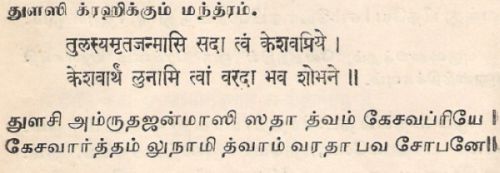
Thulasi amrudajanmaasi sadaa Dwam Kesavapriye |
Kesavaarththam lunaami Dwaam varadhaa bhava shobane ||
Thulasi Sthuthi:
Tulasi s(h)ree sakhi subE pApahAriNim puNyadhe
NamasthE nAradanuthE namO nArAyaNa priye
துளஸி ஸ்ரீஸகி சுபே பாபஹாரிணிம் புண்யதே
நமஸ்தே நாரதனுதே நமோ நாராயணப்ரியே
तुलसी श्रीसकि शुभॆ पापहारिणीम् पुण्यते ।
नमस्तॆ नारनुडे नमॊ नारायणप्रियॆ ॥
Tulasi Vivaha or Marriage day of Tulasi:
A Tulasi plant decorated for worship, with fireworks display.
Followers of Hindu traditions often keep a Tulsi plant in front of their house. On a specific day each year known as ‘Kartik Shukla Dwadashi’ (usually or or about after a fortnight from Deepavali – Diwali) there is a tradition where Tulasi plants will be beautifully decorated with structures made of small banana trees, Mango leave bunches and flowers and then perform a Pooja – a form of worship is offered.
As with Deepavali known in Northern part of India as Diwali celebrations, there are usually clay lamps lit around the Tulasi plant and the house. In some parts of India people will have also have fireworks displays to mark the occasion. In northern India and in Gaudiya Vaishnava communities it is called the ‘Tulsi vivah’ or the wedding day of Tulasi with Lord Sri Krishna in his Sila form. There is another celebration called Tulsi Ekadashi where Tulasi is worshipped on the Ekadasi day.
Quotes from the Scripts that relates to Divine Tulasi :
“As by chanting the name of The Ganga (River Ganges), one becomes free from all kinds of worldly sins; if someone chants the name of Tulasi or chants the glories of Lord Sri Hari with devotion, he gets the same merit.” – Quote from The Naradiya Purana.
“Just by touching Tulsidevi one’s body becomes pure. By praying to her, all diseases practically become removed. If one waters her or makes her wet, the fear of Yama Dharma Raja (The death personified) is destroyed.” – Tha Skanda Purana
“Tulasi is most beloved of Lord Krishna and thus her leaves and flowers are also most dear to Him.” – Srilasri Bhaktisiddhanta Saraswathi Thakura.
“Tulasi leaf is very, very dear to Lord Sri Mahavishnu ( Vishnu Tulasi Priyaa) – Sri Bhativedanta Swami Prabhupada.
“Tulasi Daivam Mahathmeeyam” – Tulasi in Itself is God, and the values are innumerable by counts – St. Vyasa Maha Muni.
“Vishnu Tulasi Priya” – Krishna Yajur Veda
Tulasi as a deity:
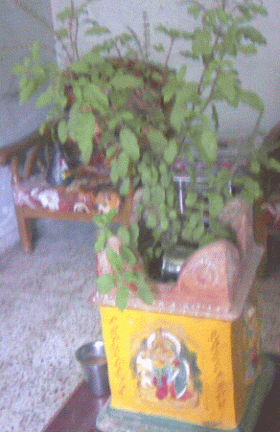
Tulsi as worshiped in deity form. The presence of a Tulsi plant in a home is considered as presence of Goddess Lakshmi herself; it symbolizes the religious bent of a Hindu family. In a Srivaishnavite household, it is considered incomplete if it doesn’t have a Tulasi plant. Many families have the Tulasi planted in a specially built structure, which has images of deities installed on all four sides, and an alcove for small earthen oil lamp. Some households can even have many plants and varities in their fore-house or at their verandah; affordable persons even cultivate it in their garden forming a “Tulsi-van” or “Tulsi-vrindavan” — a mini- basil garden.
Places that tend to inspire concentration and places ideal for worship, according to the Gandharva tantra, include “grounds overgrown with Tulsi plants”. The Tulsi Manas Mandir at Varanasi is one such famous temple, where Tulasi is worshipped along with other devas (demi-gods/goddesses). Vaishnavites, or followers of Vishnu, revere the Tulasi leaf because it pleases Lord Sri Maha Vishnu the most and thus is as an inherent part of offerings of naivedyam and then offer these Tulsi to the devotees as Prasad. They also wear beaded necklaces made of Tulasi stems. The manufacture of these Tulasi necklaces is a cottage industry in places of pilgrimage spots and at most srivaishnav temple towns. The other names used by different sects of Srivaishnavas such as Gaudia, Chaitanya Sect are Vrindadevi, meaning ‘the goddess of Brindavan aka Vrindavan. Only Sri Andal, the Tamil poet considered as one of the Azhwars stated in Her pasurams Tulsi as “Thiruthuzai”.
Interestingly, the following bit of information was supplied to me via E-mail, by one Ms. Vani Pillai (16 Years) from Singapore. She is very much interested in knowing about Hindu cultural and systems. She surfed these pages in detail and sent in few questions which I answered.
———————————————————–
I read in a Tamil book, ” Arul Mikka Samaya Katturaikal” the following information.
Scientists were trying to photograph the star, namely Thiruvatharai. However, since it is the star of the Shiva, it was fiery, and the shot would always be “burnt”. However, one German photographer, had the star in a clear shot. This happened when the thiruvonam star was facing the thiruvatarai star. Thus the Thiruvonam star had the calming effect.
Therefore, for Shiva , the vilvam leaf is offered which is cooling effect as he has a fiery star.
Therefore , for Thirumal (Sri Mahavishnu), the Tulsi leaf has the heating effect as he was a cooling star.
That’s why, it is not advised to present Tulsi (Thulsi) leaf to Shiva or vice versa.

Leave a Comment
You must be logged in to post a comment.